
Rated 4.9 out of 5


INSTANT DOWNLOAD
LittleBear Nose Breathing Handbook for Kids (E-book)
$14.99
$24.99
Save
$10.00
A 50 page illustrated handbook that teaches your child where the tongue belongs, so the lips close and the nose takes over. Read it together, five minutes a day. Twenty four chapters, five exercise levels and a twenty eight day chart they fill in themselves.
-
Teaches nose breathing, not nagging

-
Five minutes a day, done together

-
24 chapters and 5 exercise levels

-
28 day chart and a certificate

-
Instant PDF, reads on any device


Instant PDF Download
Reads On Any Device
The handbook
A book your child reads with you, not a program you have to enforce
Fifty illustrated pages that teach one idea until it sticks: the tongue has a home on the roof of the mouth, and when it rests there the lips close and the nose takes over. Your child reads the main text. You get the tinted Grown Up Corner boxes underneath, where the mechanism, the evidence and the warnings live.
Twenty four chapters, five exercise levels, a twenty eight day chart they fill in themselves and a certificate at the end. Five minutes a day. Nothing to buy, nothing to wear, nothing for a child to remember on their own.
How the handbook helps
-
It gives the tongue somewhere to go
Most advice tells a child to close their mouth. This teaches them where the tongue rests instead, which is the part that makes the mouth stay closed on its own.
-
It turns the work into a game
The Tongue Academy runs in five levels with names children remember: Spot Hold, Suction Cup, Popcorn Click, Cheek Balloons, Chew Like a Wolf.
-
It shows you what to look for first
Five mirror tests and a baseline page, so you can tell whether your child is actually a mouth breather before you change anything.
-
It puts the red flags before the exercises
The signs that mean a clinician comes first sit in Chapter Nine, ahead of the practice chapters, not buried at the back.
-
It handles the day your child refuses
A whole chapter on resistance, plus the habits that quietly undo the work and how to keep a streak alive without a fight.
-
It is honest about the limits
Chapter Twenty Two says plainly what this will and will not do, including the things the research does not support.
What parents say
The mirror tests were the part that got me. I had been told he was just a noisy sleeper for two years. Reading the chapter together and letting him find The Spot himself made it his project instead of mine.
We are on day nineteen of the chart. She asks to do it now, which I did not expect. The Grown Up Corners are what sold me, because I could see why each exercise was there rather than just being told to do it.
I appreciated that it tells you when to stop and see someone. We went to the GP after the red flags chapter and got a referral. The exercises came after that, which felt like the right order.
Why the tongue decides how a child breathes
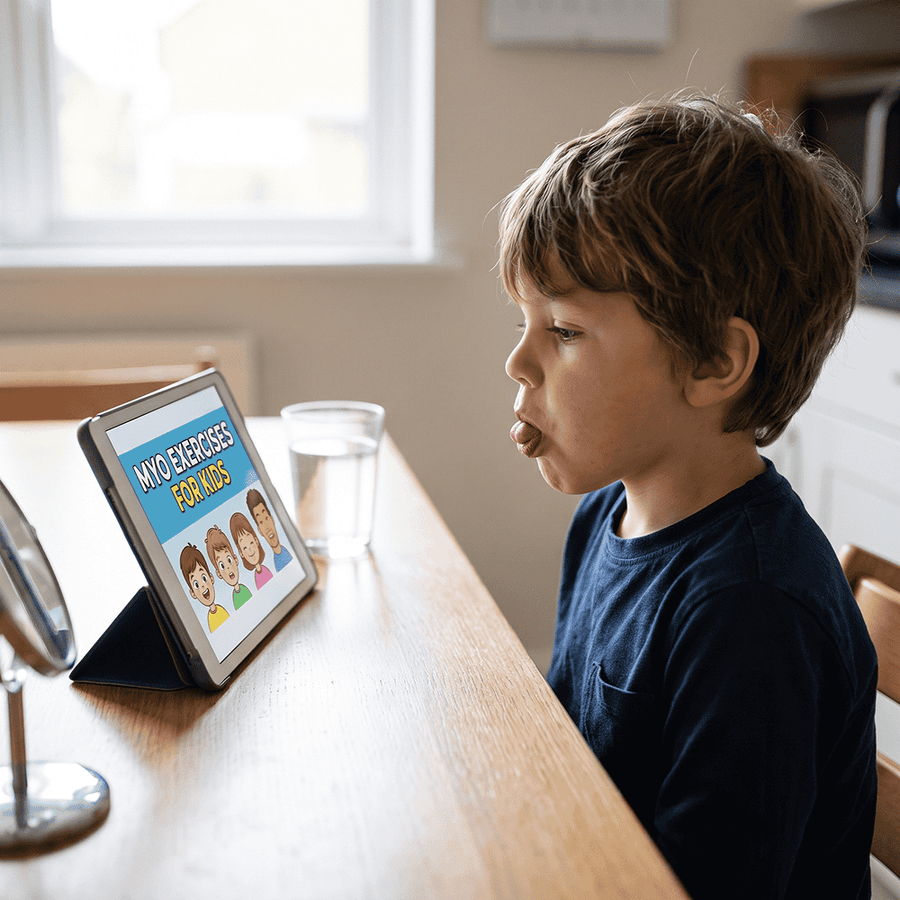
The tongue is eight muscles, and they spend the whole day and night holding a position. When that position is the roof of the mouth, the tongue sits out of the airway, the lips meet, and air goes through the nose where it is filtered, warmed and humidified on the way to the lungs. When it rests on the floor of the mouth instead, the lips part and the mouth becomes the default route. Children swallow between five hundred and seven hundred times a day, and every one of those swallows reinforces one pattern or the other.
What the research actually shows
Myofunctional therapy is not a cure and this book never calls it one. A 2015 review in Sleep reported meaningful reductions in sleep disordered breathing measures, though only two of its eleven studies were in children, and the book prints that caveat on the same page as the number. A 2026 overview in the Journal of Sleep Research found therapy outperformed controls across nine systematic reviews, and a 2023 paper in Children found the effect grows with how consistently the exercises are actually done. Two widely quoted statistics were deliberately left out, because they trace back to marketing pages rather than to a study anyone can read.

The twenty eight day mission
Five minutes a day, one level a week. Your child ticks the chart themselves.
| Days | Level | What they practise | What to look for |
|---|---|---|---|
| 1 to 7 | One. Finding the bed | Spot Touch and Spot Hold. Learning where the tongue lives and leaving it there. | They can find The Spot without a mirror and without being asked. |
| 8 to 14 | Two. Strong tongue | Suction Cup, Popcorn Click and Sticky Peanut Butter for lift and control. | The suction holds for a slow count instead of popping straight off. |
| 15 to 21 | Three. Strong lips and cheeks | Lip Seal Hold, Button Pull, Cheek Balloons and Straw Sip. | Lips stay together while they read or watch something, without effort. |
| 22 to 28 | Four and Five. The secret swallow, chew like a wolf | The 4S swallow sequence and chewing evenly on both sides. | They swallow without the chin or lips moving. Certificate earned. |
Start tonight, five minutes at a time
Instant download. The PDF arrives by email the moment you order and reads on a phone, a tablet or paper.
